

call us today (813) 213-0000
What Injuries Are Most Difficult to Prove After an Accident in Florida?
Sep 22
2026
If you’re injured in an accident, having medical proof of your injuries opens up the possibility of receiving payouts from insurance or personal injury claims. However, some injuries may elude swift diagnosis. Which injuries are the toughest to prove after an accident? At Paul Figueroa Law, we have the knowledge to help accident clients get the money they’re owed for diagnostically complex injuries.
Head and Neck Injuries
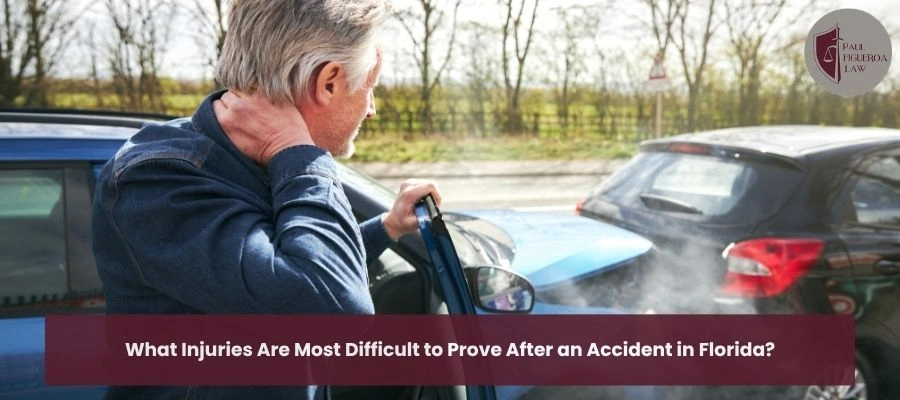
One of the most common, but still underdiagnosed, injuries in vehicle accident survivors is whiplash, an umbrella term for various neck injuries caused by the head suddenly whipping forward or backward. Symptoms of whiplash include neck pain, stiffness, and reduced range of motion, as well as neurological symptoms like numbness and confusion.
Concussion, a type of traumatic brain injury (TBI), often co-occurs with whiplash; the wrenching motion that causes whiplash can also make the brain collide violently with the skull. Severe or repeated concussions can lead to long-term brain damage and other chronic and disabling conditions.
Symptoms of both concussion and whiplash often take days or even weeks to develop, and these injuries aren’t visible on standard first-line imaging tests like X-rays, which can make diagnosis quite tricky.
Nerve Damage
Neuropathy, or nerve damage outside the central nervous system, can result from whiplash and many other kinds of trauma sustained in vehicular accidents. It may manifest as chronic muscle weakness, numbness, and pain that can significantly affect one’s quality of life. Diagnosis is often difficult and time-consuming due to the multitude of possible causes and the amount of testing required to rule out other conditions.
Thoracic and Abdominal Organ Damage
Aside from the brain, other internal organs may (less commonly) be injured in collisions; they may be bruised or torn by intense force, or punctured by fractured bones or foreign objects. Although some such injuries may be immediately life-threatening, others may not be noticed for some time and require medical tests to diagnose. It is very important to seek medical attention after a crash to check for unseen internal damage.
Psychological Harm
Post-traumatic stress disorder (PTSD) is quite prevalent among car crash survivors, but it’s unfortunately very underdiagnosed. People may not recognize their condition or avoid seeking evaluation out of shame. Symptoms such as mood changes, insomnia, and memory problems may be mistaken for indications of other illnesses, like depression or TBI.
The Importance of Injury Documentation for Insurance and Damage Claims
Without proper documentation of your injury, your insurance may reject your claim, and a court is unlikely to accept your claim for damages without proof of a serious injury.
First, let’s consider insurance. Florida’s personal injury laws require all owners of cars or trucks registered in the state to carry $10,000 in Personal Injury Protection (PIP) insurance. PIP covers the policyholder, family members in their household, and passengers in their vehicle who don’t own their own vehicles. The insurance will pay up to 80% of medical bills and up to 60% of lost wages, capped at $10,000.
Only an injury diagnosed by a physician as an “emergency medical condition” or a “serious injury” qualifies one for the full PIP payout, however. According to Florida Statute 316.027(1)(a), injuries count as “serious” when they create a significant risk of death, long-term loss of use or function of a body part, or significant disfigurement. Anything less than that, and PIP will only pay up to $2,500.
The “serious injury” threshold also matters for personal injury claims. Florida Statute 627.737 exempts vehicle owners and drivers from being held liable for injuring others in car accidents unless those injuries are serious.
If you can prove that you suffered such an injury, you may be able to recover medical expenses and lost wages beyond the $10,000 PIP limit; you may also pursue damages for non-economic losses stemming from the injury, like physical and emotional distress.
Personal injury claims are complicated and must be executed carefully, especially when it comes to truck accident cases, where multiple entities can be responsible. A knowledgeable Tampa truck accident lawyer can help you understand your options and assist you in pursuing your case against all liable parties.
Accidents in Hillsborough County
In 2023, Hillsborough County saw 27,474 reported total vehicle crashes, resulting in 18,873 injuries. Commercial truck vehicle crashes made up 3,083 of these accidents.
Although Miami-Dade County had a higher rate of accidents overall, Hillsborough County had a higher rate of truck crash injuries, at 59 injuries per 100,000 residents compared to Miami-Dade’s 47 per 100,000.
FAQs
Can I Get Money for Injuries if the Accident Was Partly My Fault?
Yes, you can get money for injuries if the accident was your fault. Florida is a “no-fault” state, meaning you are eligible for PIP payouts for an accident, no matter who is at fault. You can also recover damages if you meet the serious injury threshold and the court assigns you 50% or less fault for the accident, per Florida’s comparative fault laws.
What Is the Average Damages Payout for Car Accident Injuries?
There is no average payout for car accident injuries. The amount you can reasonably claim in damages depends on many factors, including how severe your injury is and how much it affects your ability to live and enjoy your life. If you believe you have a strong case for damages against a negligent driver, it is wise to hire a personal injury lawyer to help you calculate how much to claim.
Should I Accept a Settlement for My Car Accident Injury?
If you don’t feel you’ve been offered a reasonable settlement for your personal injury damages claim by the other party’s insurer, it is recommended to consult a personal injury attorney before you accept the offer. Accepting an offer means giving up the right to pursue further claims for damages.
When Are Personal Injury Protection Benefits Overdue in Florida?
Personal Injury Protection benefits are overdue if your insurer does not pay out your benefits within 30 days of receiving written notice of your covered injury and the amount you are claiming, provided they have reasonable proof of your claim. If they do not think they have reasonable proof and decide to deny your claim, the payment is not considered overdue.
Hire a Personal Injury Lawyer
If you’re looking for strong, compassionate representation in your personal injury case, reach out to us at Paul Figueroa Law today to schedule your initial consultation. Our office is located in Tampa, and we serve clients throughout Florida.
Follow Us
Contact Us
806 E Jackson Street
Suite 1
Tampa, FL 33602
By appointment only.
Office Phone Number (813) 213-0000
Fax Number(813) 902-7000


Operating

Trust
Copyright © 2026 Paul Figueroa Law. All rights reserved. Disclaimer | Site Map | Privacy Policy
*Images are obtained under license from Canva and other third-party stock image providers, with attribution included where required.
Digital Marketing By 